GCN 44767: GRB 260601B: GECAM-B detection of a burst probably associated with EP260601a
Zheng-Hang Yu, Chen-Wei Wang, Shao-Lin Xiong, Chao Zheng (IHEP) report on behalf of GECAM team:

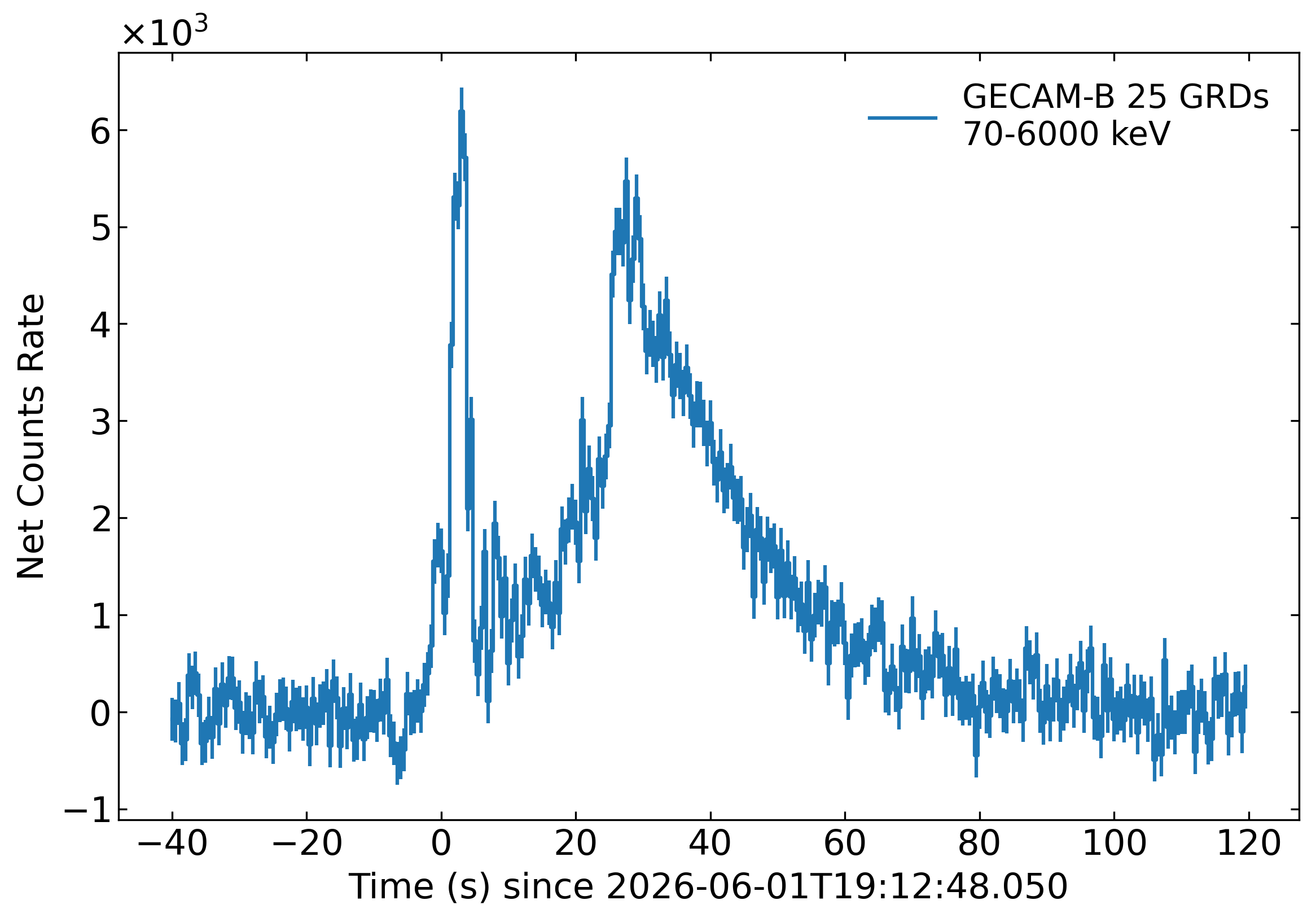
GECAM-B was triggered in-flight by a burst GRB 260601B at 2026-06-01T19:12:48.050 UTC (denoted as T0). According to the GECAM-B light curves in about 70-6000 keV, this burst mainly consists of a possible precursor and then a short pulse followed by a long emission with a duration (T90) of 66.5 +2.5/-3.5 s.

The on-ground localization of GECAM-B is:
Ra: 271.2 deg
Dec: -5.5 deg
Err: 2.7 deg (1-sigma, statistical only)

Considering systematic uncertainties, this localization is consistent with the EP/WXT localization of EP260601a (Yang et al., GCN#44766). The time coincidence and localization coincidence between GRB 260601B and EP260601a strongly support the association of these two events.

The GECAM-B light curve can be found here:
https://www.bursthub.cn//admin/static/gecambgrb260601B.png

Gravitational wave high-energy Electromagnetic Counterpart All-sky Monitor (GECAM) mission originally consists of two micro-satellites (GECAM-A and GECAM-B) launched in Dec. 2020. As the third member of GECAM constellation, GECAM-C was launched onboard SATech-01 experimental satellite in July 2022. GECAM mission is funded by the Chinese Academy of Sciences (CAS).