GCN 43602: GRB 260130A: GECAM-B observation of a short burst
Jin-Peng Zhang, Chen-Wei Wang, Shao-Lin Xiong (IHEP) report on behalf of GECAM team:

GECAM-B was triggered in-flight by GRB 260130A, at 2026-01-30T13:29:20.850 UTC (denoted as T0), which is also detected by Fermi/GBM (Fermi GBM team, GCN #43569; A. Jameson et al., GCN #43575).

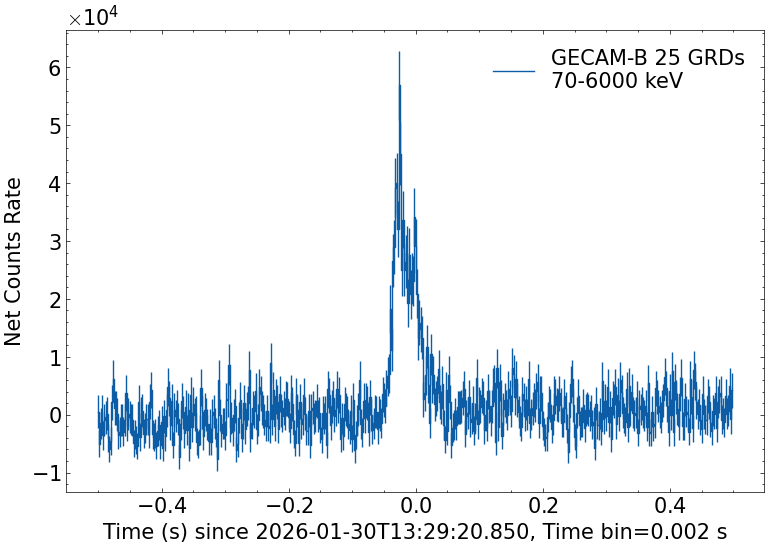
According to the GECAM-B light curves in about 70-6000 keV, this burst mainly consists of a bright short pulse, with a duration (T90) of 0.083 +/- 0.009 s.

The GECAM-B light curve can be found here:
https://www.bursthub.cn//admin/static/gecambgrb260130A.png

The time-averaged spectrum from T0 - 0.05 to T0 + 0.02 s is best fitted by a power law function with an exponential high-energy cutoff. The power law index is -0.52 +0.23/-0.24 and the cutoff energy, parameterized as Epeak, is 860 +190/-140 keV. The event fluence (10-1000 keV) in this time interval is (1.28 +0.11/-0.10)E-06 erg/cm^2.

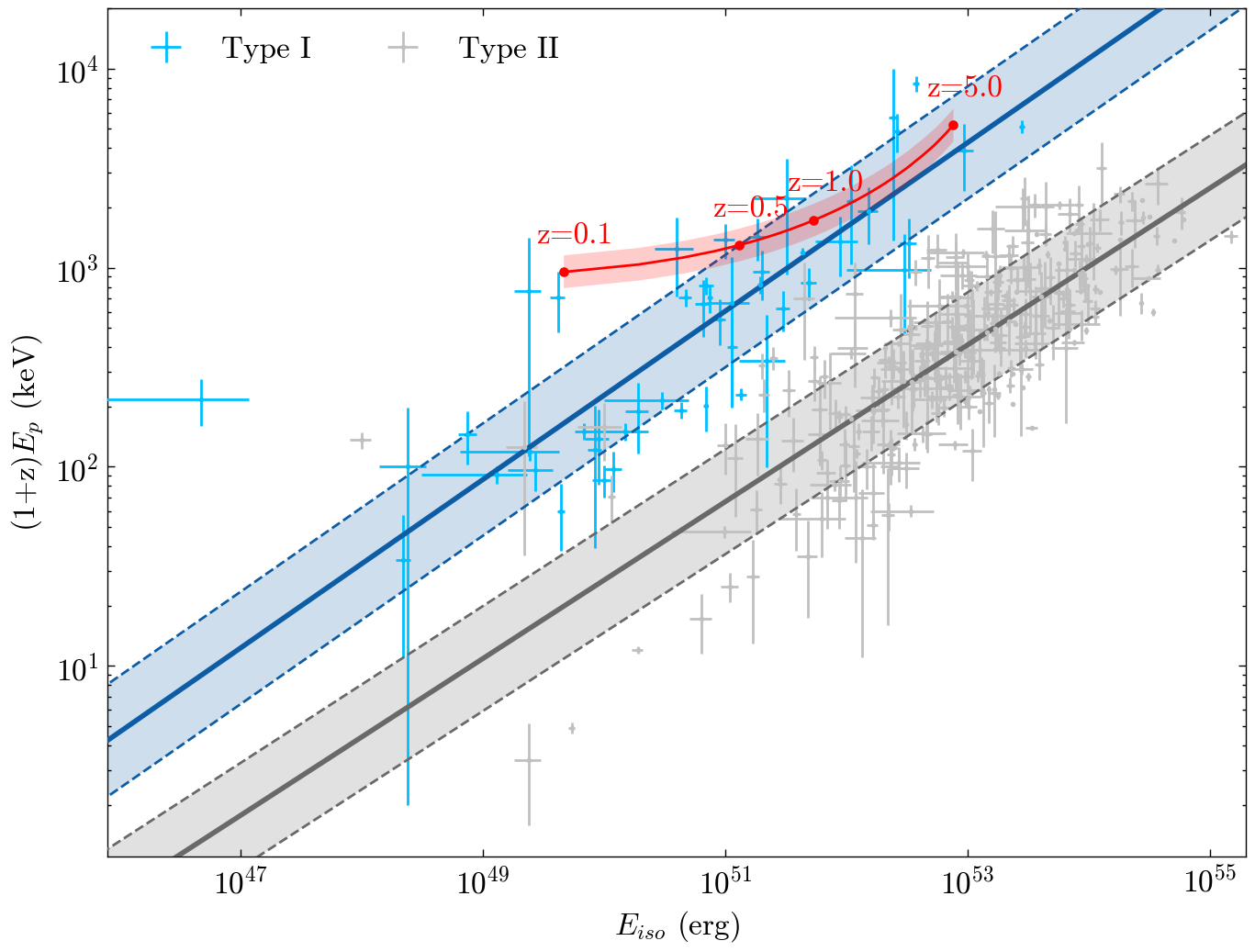
The 'Amati' relation diagram of GRB 260130A is shown at:
https://www.bursthub.cn//admin/static/gecambgrb260130A_amati.png

Gravitational wave high-energy Electromagnetic Counterpart All-sky Monitor (GECAM) mission originally consists of two micro-satellites (GECAM-A and GECAM-B) launched in Dec. 2020. As the third member of GECAM constellation, GECAM-C was launched onboard SATech-01 experimental satellite in July 2022. GECAM mission is funded by the Chinese Academy of Sciences (CAS).